/* Written by Dan Heller and Paula Ferguson.
 * Copyright 1994, O'Reilly & Associates, Inc.
 * Permission to use, copy, and modify this program without
 * restriction is hereby granted, as long as this copyright
 * notice appears in each copy of the program source code.
 * This program is freely distributable without licensing fees and
 * is provided without guarantee or warrantee expressed or implied.
 * This program is -not- in the public domain.
 */

/* action_area.c -- demonstrate how CreateActionArea() can be used
 * in a real application.  Create what would otherwise be identified
 * as a PromptDialog, only this is of our own creation.  As such,
 * we provide a TextField widget for input.  When the user presses
 * Return, the OK button is activated.
 */
#include <Xm/DialogS.h>
#include <Xm/PushBG.h>
#include <Xm/PushB.h>
#include <Xm/LabelG.h>
#include <Xm/PanedW.h>
#include <Xm/Form.h>
#include <Xm/RowColumn.h>
#include <Xm/TextF.h>

typedef struct {
    char *label;
    void (*callback)();
    XtPointer data;
} ActionAreaItem;

static void
    do_dialog(), close_dialog(), activate_cb(),
    ok_pushed(), clear_pushed(), help();

main(argc, argv)
int argc;
char *argv[];
{
    Widget toplevel, button;
    XtAppContext app;

    XtSetLanguageProc (NULL, NULL, NULL);

    toplevel = XtVaAppInitialize (&app, "Demos",
        NULL, 0, &argc, argv, NULL, NULL);

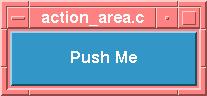
    button = XtVaCreateManagedWidget ("Push Me",
        xmPushButtonWidgetClass, toplevel, NULL);
    XtAddCallback (button, XmNactivateCallback, do_dialog, NULL);

    XtRealizeWidget (toplevel);
    XtAppMainLoop (app);
}

/* callback routine for "Push Me" button.  Actually, this represents
 * a function that could be invoked by any arbitrary callback.  Here,
 * we demonstrate how one can build a standard customized dialog box.
 * The control area is created here and the action area is created in
 * a separate, generic routine: CreateActionArea().
 */
static void
do_dialog(w, client_data, call_data)
Widget w; /* will act as dialog's parent */
XtPointer client_data;
XtPointer call_data;
{
    Widget dialog, pane, rc, text_w, action_a;
    XmString string;
    extern Widget CreateActionArea();
    static ActionAreaItem action_items[] = {
        { "OK",     ok_pushed,     NULL          },
        { "Clear",  clear_pushed,  NULL          },
        { "Cancel", close_dialog,  NULL          },
        { "Help",   help,          "Help Button" },
    };

    /* The DialogShell is the Shell for this dialog.  Set it up so
     * that the "Close" button in the window manager's system menu
     * destroys the shell (it only unmaps it by default).
     */
    dialog = XtVaCreatePopupShell ("dialog",
        xmDialogShellWidgetClass, XtParent (w),
        XmNtitle,  "Dialog Shell",     /* give arbitrary title in wm */
        XmNdeleteResponse, XmDESTROY,  /* system menu "Close" action */
        NULL);

    /* now that the dialog is created, set the Cancel button's
     * client data, so close_dialog() will know what to destroy.
     */
    action_items[2].data = (XtPointer) dialog;

    /* Create the paned window as a child of the dialog.  This will
     * contain the control area and the action area
     * (created by CreateActionArea() using the action_items above).
     */
    pane = XtVaCreateWidget ("pane", xmPanedWindowWidgetClass, dialog,
        XmNsashWidth,  1,
        XmNsashHeight, 1,
        NULL);

    /* create the control area which contains a
     * Label gadget and a TextField widget.
     */
    rc = XtVaCreateWidget ("control_area", xmRowColumnWidgetClass, pane, NULL);
    string = XmStringCreateLocalized ("Type Something:");
    XtVaCreateManagedWidget ("label", xmLabelGadgetClass, rc,
        XmNlabelString,    string,
        NULL);
    XmStringFree (string);

    text_w = XtVaCreateManagedWidget ("text-field",
        xmTextFieldWidgetClass, rc, NULL);

    /* RowColumn is full -- now manage */
    XtManageChild (rc);

    /* Set the client data for the "OK" and "Cancel" buttons */
    action_items[0].data = (XtPointer) text_w;
    action_items[1].data = (XtPointer) text_w;

    /* Create the action area. */
    action_a = CreateActionArea (pane, action_items, XtNumber (action_items));

    /* callback for Return in TextField.  Use action_a as client data */
    XtAddCallback (text_w, XmNactivateCallback, activate_cb, action_a);

    XtManageChild (pane);
    XtPopup (dialog, XtGrabNone);
}

/* The next four functions are the callback routines for the buttons
 * in the action area for the dialog created above.  Again, they are
 * simple examples, yet they demonstrate the fundamental design approach.
 */
static void
close_dialog(w, client_data, call_data)
Widget w;
XtPointer client_data;
XtPointer call_data;
{
    Widget shell = (Widget) client_data;

    XtDestroyWidget (shell);
}

/* The "ok" button was pushed or the user pressed Return */
static void
ok_pushed(w, client_data, call_data)
Widget w;
XtPointer client_data;
XtPointer call_data;
{
    Widget text_w = (Widget) client_data;
    XmAnyCallbackStruct *cbs = (XmAnyCallbackStruct *) call_data;
    char *text = XmTextFieldGetString (text_w);

    printf ("String = %s\n", text);
    XtFree (text);
}

static void
clear_pushed(w, client_data, call_data)
Widget w;
XtPointer client_data;
XtPointer call_data;
{
    Widget text_w = (Widget) client_data;
    XmAnyCallbackStruct *cbs = (XmAnyCallbackStruct *) call_data;

    /* cancel the whole operation; reset to NULL. */
    XmTextFieldSetString (text_w, "");
}

static void
help(w, client_data, call_data)
Widget w;
XtPointer client_data;
XtPointer call_data;
{
    String string = (String) client_data;

    puts(string);
}

/* When Return is pressed in TextField widget, respond by getting
 * the designated "default button" in the action area and activate
 * it as if the user had selected it.
 */
static void
activate_cb(text_w, client_data, call_data)
Widget text_w;              /* user pressed Return in this widget */
XtPointer client_data;        /* action_area passed as client data */
XtPointer call_data;
{
    XmAnyCallbackStruct *cbs = (XmAnyCallbackStruct *) call_data;
    Widget dflt, action_area = (Widget) client_data;

    /* get the "default button" from the action area... */
    XtVaGetValues (action_area, XmNdefaultButton, &dflt, NULL);
    if (dflt) /* sanity check -- this better work */
        /* make the default button think it got pushed using
         * XtCallActionProc().  This function causes the button
         * to appear to be activated as if the user pressed it.
         */
        XtCallActionProc (dflt, "ArmAndActivate", cbs->event, NULL, 0);
}

#define TIGHTNESS 20

Widget
CreateActionArea(parent, actions, num_actions)
Widget parent;
ActionAreaItem *actions;
int num_actions;
{
    Widget action_area, widget;
    int i;

    action_area = XtVaCreateWidget ("action_area", xmFormWidgetClass, parent,
        XmNfractionBase, TIGHTNESS*num_actions - 1,
        XmNleftOffset,   10,
        XmNrightOffset,  10,
        NULL);

    for (i = 0; i < num_actions; i++) {
        widget = XtVaCreateManagedWidget (actions[i].label,
            xmPushButtonWidgetClass, action_area,
            XmNleftAttachment,       i? XmATTACH_POSITION : XmATTACH_FORM,
            XmNleftPosition,         TIGHTNESS*i,
            XmNtopAttachment,        XmATTACH_FORM,
            XmNbottomAttachment,     XmATTACH_FORM,
            XmNrightAttachment,
                i != num_actions - 1 ? XmATTACH_POSITION : XmATTACH_FORM,
            XmNrightPosition,        TIGHTNESS * i + (TIGHTNESS - 1),
            XmNshowAsDefault,        i == 0,
            XmNdefaultButtonShadowThickness, 1,
            NULL);
        if (actions[i].callback)
            XtAddCallback (widget, XmNactivateCallback,
                actions[i].callback, actions[i].data);
        if (i == 0) {
            /* Set the action_area's default button to the first widget
             * created (or, make the index a parameter to the function
             * or have it be part of the data structure). Also, set the
             * pane window constraint for max and min heights so this
             * particular pane in the PanedWindow is not resizable.
             */
            Dimension height, h;
            XtVaGetValues (action_area, XmNmarginHeight, &h, NULL);
            XtVaGetValues (widget, XmNheight, &height, NULL);
            height += 2 * h;
            XtVaSetValues (action_area,
                XmNdefaultButton, widget,
                XmNpaneMaximum,   height,
                XmNpaneMinimum,   height,
                NULL);
        }
    }

    XtManageChild (action_area);

    return action_area;
}